
Automated bookkeeping for small UK hospitality businesses

Updated: Apr 24

If you run a small café, pub, or restaurant in the UK, chances are your bookkeeping sits somewhere between a spreadsheet and a shoebox of receipts. Manual record-keeping is time-consuming, error-prone, and quietly stressful when VAT deadlines approach. Many owner-operators assume that automated bookkeeping is something only larger chains can afford or benefit from. That assumption is costing you time and money. This guide explains what automated bookkeeping actually means for hospitality businesses under £200,000 turnover, how it works in practice, and how you can start using it without overhauling everything at once.
Table of Contents
Key Takeaways
Point | Details |
Automation redefines finance | Automated bookkeeping changes day-to-day finance management for hospitality businesses, enabling accurate, real-time insights. |
Human oversight remains crucial | AI and automation flag financial risks, but accountants are vital for providing judgement and advice. |
Integration is the key | Linking POS/PMS systems with automated bookkeeping simplifies compliance and reduces errors. |
Accessible solutions for small firms | Simple, affordable automation options support hospitality businesses under £200,000 turnover. |
Understanding automated bookkeeping in hospitality
Automated bookkeeping uses software to capture, categorise, and reconcile financial transactions with minimal manual input. Instead of logging every sale, supplier invoice, or staff cost by hand, the system pulls data from connected sources and organises it automatically. For a small hospitality business, that means your daily takings, food costs, and payroll figures can flow into your accounts without you touching a spreadsheet.
The most relevant tools for hospitality fall into two broad categories. First, cloud-based accounting platforms like Xero connect directly to your bank feeds and generate real-time financial reports. Second, integrations with your Point of Sale (POS) system, the till or tablet your staff use to process orders, push sales data straight into your accounts. Some businesses also use a Property Management System (PMS), which handles reservations and room charges if accommodation is part of the offering. Hospitality bookkeeping automation that links these systems together is where the real efficiency gains appear.
Research confirms that automation integrates with POS and PMS systems and prevents margin erosion by tracking financials in real time, redefining how accountants support small businesses.
Here is a straightforward comparison of the two approaches:
Feature | Manual bookkeeping | Automated bookkeeping |
Data entry | Done by hand | Pulled from connected systems |
Error rate | Higher | Significantly lower |
VAT preparation | Time-intensive | Largely automated |
Real-time visibility | Limited | Continuous |
Cost at small scale | Appears cheaper | Better value over time |
For businesses under £200,000 turnover, the core automation features that deliver the most value are:
Bank feed reconciliation: Matches transactions automatically against your records
POS integration: Imports daily sales without manual entry
Supplier invoice capture: Tools like Apron scan and log invoices on receipt
VAT calculation: Tracks eligible transactions and prepares returns
Payroll syncing: Connects staff hours and wages to your accounts
Anomaly flagging: Highlights unusual figures for human review
Even if your turnover is modest, these features remove the repetitive admin that eats into your evenings and weekends.
Practical impact on compliance and financial management
Compliance is where automation earns its keep most clearly. For small hospitality businesses, the two biggest obligations are VAT returns (filed quarterly under Making Tax Digital rules) and year-end accounts. Both require accurate, up-to-date records. When bookkeeping is manual, these tasks pile up and mistakes creep in. When it is automated, the data is already there, organised and ready.
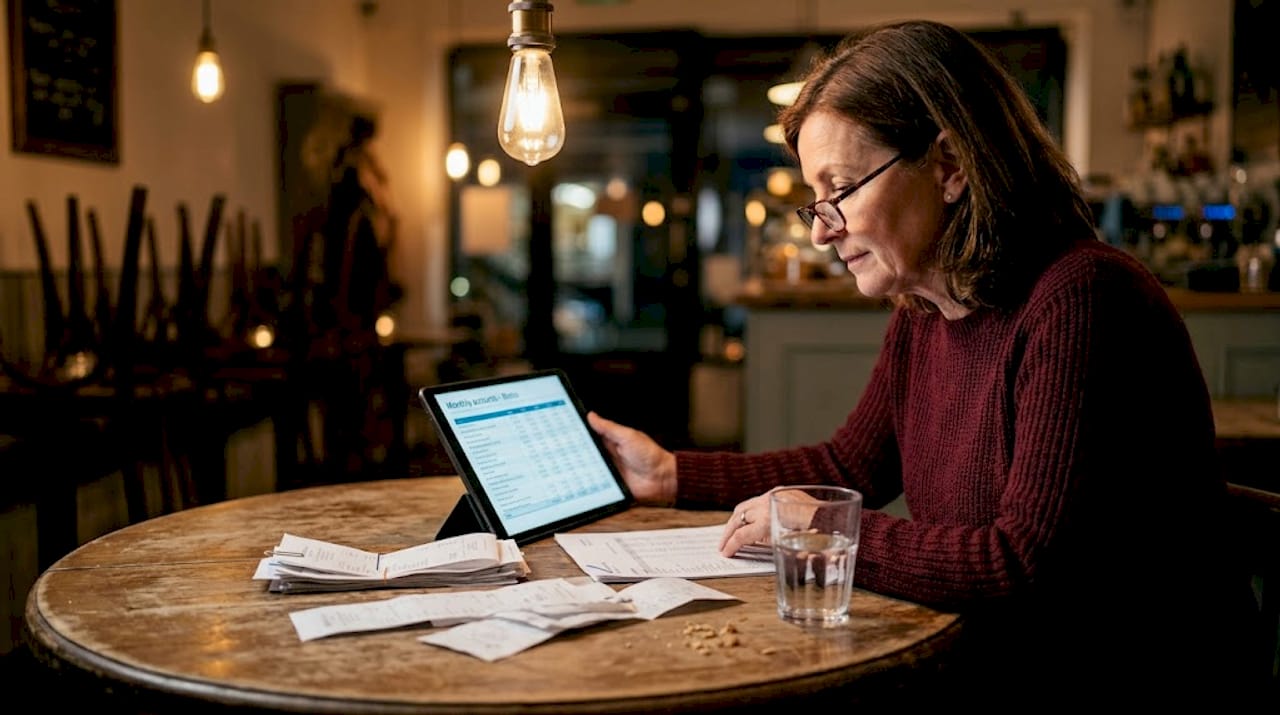
Automated systems track gross profit in real time and flag anomalies for human review, which means you are not waiting until month-end to discover your food cost has crept above target.
Real-time gross profit tracking is particularly valuable in hospitality because margins are tight. Here is how it helps in practice:
Daily sales are imported automatically from your POS, giving you an accurate revenue figure each morning
Supplier costs are logged on receipt, so your cost of goods is always current
Gross profit is calculated continuously, not just at month-end
Alerts flag unusual variances, such as a sudden spike in food cost or a dip in average transaction value
VAT-eligible transactions are tracked throughout the quarter, so there are no surprises when the return is due
That said, automation is not a set-and-forget solution. Flagged anomalies still need a human to decide whether they represent a genuine problem or a data quirk. A supplier invoice coded to the wrong category, for example, will not fix itself.
Pro Tip: Set specific thresholds for your anomaly alerts. If your food cost normally sits at 28 to 32 percent, configure your system to flag anything outside that range. Vague alerts get ignored; precise ones prompt action.
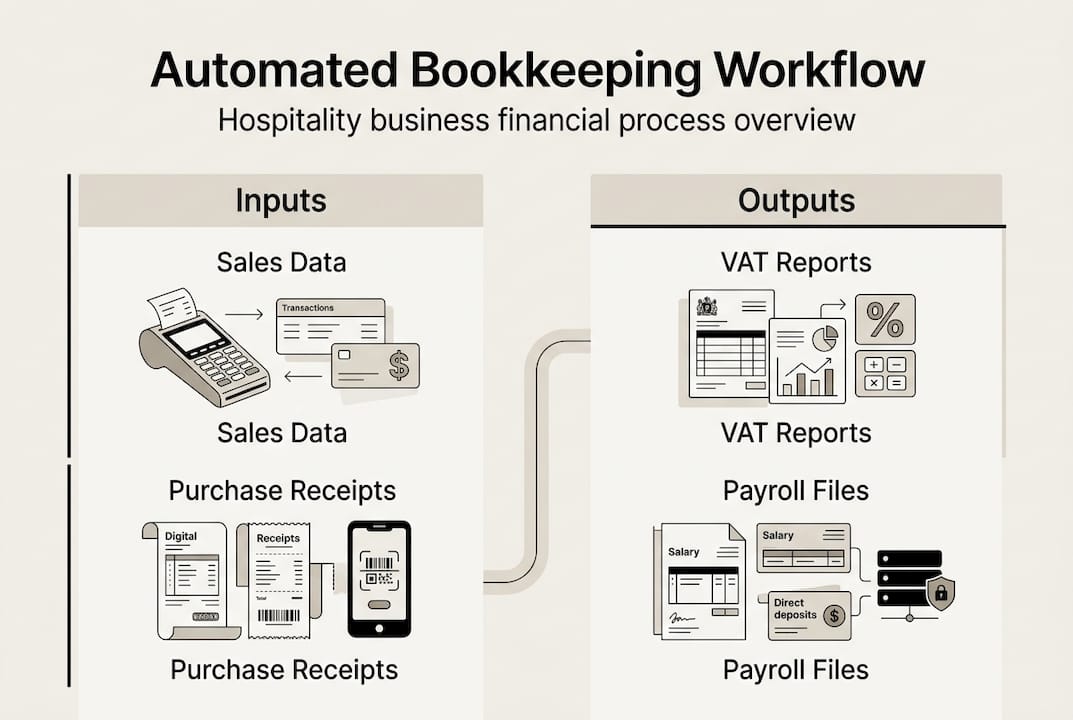
A typical automated workflow for a small hospitality business looks like this: sales data flows in from the POS each day, supplier invoices are captured via an app like Apron, bank transactions are reconciled automatically, and your accountant reviews the figures weekly or monthly. Specialist hospitality accounting support means someone qualified is checking those figures and catching anything the system misses. The result is that bookkeeping for restaurants and similar businesses becomes a background process rather than a weekly ordeal.
Integrating bookkeeping automation with hospitality systems
A POS system is the device or software your team uses to take orders and process payments. A PMS handles reservations, tables, or rooms depending on your business type. Both generate financial data that, without automation, would need to be manually transferred into your accounts. Integration removes that step entirely.
The choice between a standalone bookkeeping tool and a fully integrated solution matters more than most small operators realise:
Approach | Standalone tool | Integrated solution |
Setup complexity | Low | Medium |
Data accuracy | Depends on manual input | High (automated feeds) |
Time saving | Moderate | Significant |
Cost | Lower upfront | Better long-term value |
Compliance support | Basic | Strong |
For practical integration, the steps are straightforward. Connect your POS to your accounting platform, set up bank feeds, configure your chart of accounts to reflect hospitality categories (food, beverage, labour, rent), and then test the data flow before going live. Good bookkeeping automation onboarding support makes this process much less daunting.
Common pitfalls to avoid during integration:
Skipping the chart of accounts setup: Generic categories do not reflect hospitality costs accurately
Assuming the integration is complete after connection: Always verify that data is flowing correctly
Ignoring staff training: If your team processes refunds or voids incorrectly at the till, those errors will carry through to your accounts
Overlooking VAT codes: Incorrect VAT treatment on food and drink items is a frequent compliance issue
Not reviewing flagged transactions: Automation surfaces problems; humans must resolve them
On that last point, it is worth being direct:
“Automation needs human judgement for reviewing flagged anomalies and ensures accurate financial reporting.” Automated accounting systems
Reviewing pricing for hospitality bookkeeping options before committing helps you understand what level of human oversight is included in any service you choose.
Getting started: Selecting and adopting automated bookkeeping solutions
Choosing the right solution comes down to four criteria: integration capability, ease of use, cost, and the quality of ongoing support. For a business under £200,000 turnover, you do not need the most feature-rich platform on the market. You need something that connects to your existing systems, stays within budget, and has someone behind it who understands hospitality.
Key considerations when selecting a solution:
Does it integrate with your POS? This is non-negotiable for accurate sales data
Is it Making Tax Digital compliant? HMRC requires digital VAT records for most VAT-registered businesses
What does onboarding look like? A good provider will set up your chart of accounts and test integrations before you go live
Is support included? Ad hoc support fees add up quickly
Is the pricing fixed or variable? Fixed fees make budgeting predictable
Does the provider understand hospitality? Generic accountants often miss sector-specific nuances like split VAT rates on food and drink
Pro Tip: Prioritise solutions that offer structured onboarding and are built around UK compliance requirements. A platform that looks affordable but requires significant setup time or specialist configuration can end up costing more than a slightly higher fixed-fee service.
Research shows that AI assists with anomaly detection but final judgement remains a human task, which is why the quality of the people behind your automated bookkeeping services matters as much as the software itself.
The adoption process typically takes two to four weeks. You connect your systems, configure your settings, run a parallel period where you check automated figures against your existing records, and then switch over fully. The most common challenge is not technical. It is psychological. Many owner-operators feel uncomfortable letting go of manual control. The data, however, is consistently more accurate once automation is properly set up.
A fresh perspective: The evolving accountant’s role and what small businesses miss
Here is something most articles on this topic avoid saying plainly: automation does not just save you time. It changes what your accountant should be doing for you.
When bookkeeping is manual, your accountant spends most of their time processing data. When it is automated, that time is freed up for something far more valuable: helping you understand what your numbers mean and what to do about them. Research confirms that automation redefines the accountant’s role to advisory, while human review remains essential.
The uncomfortable truth is that many small hospitality businesses are paying for compliance and getting nothing else. They file their VAT, submit their year-end accounts, and then wonder why they still feel financially uncertain. Automation, when paired with the right advisory accounting support, shifts that dynamic. Your accountant stops being a data processor and starts being a sounding board.
The businesses that get the most from automation are not the ones with the most sophisticated software. They are the ones who use the time it frees up to actually look at their numbers and ask better questions.
Take the next step with automated hospitality bookkeeping
If you have been managing your books manually, or relying on a generic accountant who does not specialise in hospitality, there is a more straightforward path available. HospoBase is built specifically for small, single-site hospitality businesses in the UK, handling bookkeeping, VAT returns, payroll, and year-end accounts at a fixed fee of £295 + VAT per month.
We integrate with Xero and Apron so your hospitality bookkeeping solutions run in the background without constant input from you. If you are ready to stop worrying about compliance and start getting reliable numbers, you can apply for specialist accounting support today or review our pricing for bookkeeping to see exactly what is included.
Frequently asked questions
What is automated bookkeeping and why is it useful for small hospitality businesses?
Automated bookkeeping uses software to record, categorise, and analyse transactions with minimal manual input, saving time and reducing errors. For small hospitality businesses, it means POS and PMS integration keeps financial records accurate and current without daily admin.
Does automated bookkeeping fully replace an accountant?
No. Automation handles routine data processing, but qualified accountants remain essential for compliance judgement, strategic advice, and reviewing flagged anomalies. Research shows that AI flags anomalies but human review is always required for final decisions.
Is it expensive to implement automated bookkeeping for hospitality businesses under £200,000 turnover?
Affordable, fixed-fee options exist specifically for smaller hospitality operators, and costs are increasingly proportionate to business size. Automation prevents margin erosion via real-time tracking, which often delivers savings that outweigh the service cost.
How does automated bookkeeping help with compliance and tax reporting?
Automated tools track transactions continuously, prepare VAT figures throughout the quarter, and generate the reports needed for HMRC submissions. Automation supports compliance and financial management, reducing the risk of errors and missed deadlines.
Recommended
Comments